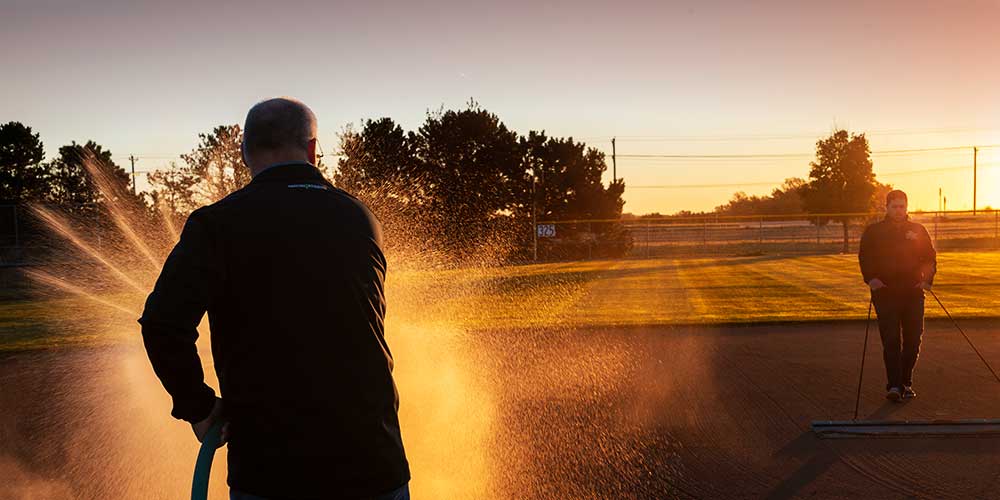

Learn from the experts in the field (since 1948).

With over 6 decades of expertise, there’s plenty to share. Everything from controlling lip buildup to recommended amounts of topdressing. If you’re looking for specifics with setting up your ballfield, check out our Ballfield Dimensions section where you’ll find everything you need to accurately lay out your ballfield.
Our team of skilled professionals includes groundskeepers & facility managers. Below are some tips and tricks from this pool of experts. If you’d like to share a tip of your own, please do. Just click below to share. Or, explore Groundskeeper U for training your seasonal staff.
Field Maintenance Tips
Infield Care
Tips for Wet Fields
Helpful tips to help you cope with wet fields.
Spring has sprung! Well, maybe it’s more fitting to say “spring is here” thanks to the squishy sound beneath my feet as I walked the ballfields at our Little League park yesterday. Winter is trying to hang on here in the northern part of the country, but I’ve seen the future … and it’s wet fields. With a wet spring predicted for much of the plains and midwest, what is a groundskeeper to do to keep his or her fields dry and playable as quickly as possible? Here are some wet field tips:
- Wait till the field has lost all frost in the soil profile before attempting any work on the skin portion.
- If your field is in the northern part of the country where you get a decent depth of frost each year (3” or more), be sure to roll the field once it has dried enough to help seal the field back up so water will run off the field more easily.
- The winds of winter can build up soil and topdressing materials into the lips of the infield skin. These lips will drastically affect the drainage of water off of your infield skin so be sure to clean out all lips.
- Make sure the surface of the skin is smooth and level. Fall is one of the best times to relevel your infield skin so there are no low spots in the skin which will collect water. This exercise best prepares your field(s) for rapid water removal in the spring.
- If it wasn’t regraded last fall, go out to the field right after a rain while there are still puddles on the infield skin and, using a rake, carve the outline of each puddle. When dry, nail drag the infield avoiding the low spots so you can find them, then use the loose infield soil to fill these low areas to help the water move off the infield more effectively.
- Keep some calcined clay drying agents around for those emergencies. But if the puddles are large, then use puddle pillows or puddle pumps to remove excess water leaving just very shallow wet areas where drying agents can then work their magic.
- Whatever you do, NEVER use brooms to sweep excess water off an infield. You will only be worsening the surface grade of the skin by sweeping more soil out which will create an even deeper hole for water to stand in. This will also build up the lips even worse creating a bigger dam along the edge.
Of course, keep in mind that a month or two from now you will be wishing for some of this moisture to come back when the dry, hot weather of June and July hit.
Control Lip Buildup
Finishing Grooming & Dragging Protocol
This portion of infield skin maintenance deserves the utmost attention to detail and finesse. Improper dragging techniques can result in problems ranging from severe lip buildup to poor skin surface drainage. These problems will create maintenance nightmares for you. They also have a negative effect on the playability and safety of these fields for ballplayers of any age!
Procedure:
- Choose a finish grooming tool that works best on your infield skin materials.
- THIS IS NOT A RACE! Slow down!
- Go slowest when cornering to prevent bowling out the infield skin area.
- Stay six inches or so away from turf edges to reduce lip buildup!
- Use a leveling bar ahead of the drag to spread out piles of soil and topdressing.
- Use a hand drag, broom, or level board to groom cutouts and baselines.
- If infield grade is perfect, end your dragging in the same spot it was started.
- To repair poor surface grade, start your dragging in high areas and end in low areas.
- Rotate starting and ending locations to prevent creating new high and low spots.
Infield Skin Topdressing Care
Spiking and Nail Dragging Protocol
Depending on depth, this procedure is performed for the following reasons:
- To maintain surface grade
- Scarify and restore smooth playing surface
- Loosen heavily compacted soils as needed
- Mix soil amendments through the infield skin profile
- Provide better resiliency
Deep Spiking and Mixing Procedure
- Most effective when infield soils have uniform moisture
- Have enough weight or down pressure for maximum penetration (greater than one inch in depth)
- Keep unit clear of soil buildup on spikes
- Crosscut and vary spiking pattern to avoid waves
Daily Field Maintenance Nail Dragging
- Only spike deep enough to remove cleat marks and bumps (less than one inch in depth)
- Nail drag to consistent depth over entire skin area
- Most effective when infield soils have uniform moisture
- Crosscut and vary spiking pattern to avoid waves
- Avoid spike chatter by slowing ground speed and balancing nail drag
- Use a hand nail drag in tight areas (cutouts, baselines, turf-soil interface)
Which drag is right for you?
Aggressive Renovation: Any soil work that would need deep soil penetration and/or mixing down 2 to 4 inches in the soil profile.
Moderate Renovation: Any soil work that would need shallow soil penetration and/or mixing down 1 to 2 inches in the soil profile.
Day-To-Day Grooming: Strictly grooming of the top 1/2 to 1 inch of infield skin.
| PRODUCT | AGGRESSIVE RENOVATION |
MODERATE RENOVATION |
FINISH GROOMING |
| Plow Pan Spiker | ◊ | † | |
| Reversible Spike Harrow | ◊ | ◊ | |
| Flexible Chain Link Harrow | † | ◊ | † |
| Beacon Premium 5×3 Nail Drag | † | ◊ | ◊ |
| Fieldmaster | ◊ | ◊ | |
| Beacon Drag Spiker | † | ◊ | |
| Steel Mat Drags w/ Leveling Bar | † | ◊ | |
| Steel Mat Drags (without bar) | ◊ | ||
| Beacon Cocoa Mat Quick Drags | ◊ | ||
| Drag Broom | ◊ |
◊ Optimal equipment for the job
† May perform satisfactorily under certain field conditions
Which finishing drag is right for your field?
| Infield Skin Type | Steel Mat Drag | Cocoa Mat Drag | Drag Broom |
| Heavy infield skin soils with no topdressing | x | ||
| Sandy infield skin soils with no topdressing | x | x | x |
| Any infield skin soil with topdressing | x | x | x |
Soil Amendment Tips
Brick Vs. Bagged Clay – Which is Right for Me?
Bagged clay on the other hand, does not require any sub-grade preparation. The shredded clay will simply fill in whatever contours may exist at the bottom of the excavated area. This process, however, requires much more physical labor in that a tremendous amount of tamping is needed to bond clay layers together and create a firm, solid base.
The Beacon Mound Slope Gauge is a great tool for helping to establish the proper sub-grade and final-grade surfaces.
Making the Decision to Add a Clay Base to the High Wear Areas of your Ballfield
Secondly, what are the maintenance capabilities of the field? Is there a full-time grounds crew that can monitor and adjust moisture levels in the clay? Or is the “grounds crew” a couple of parent/coaches that help in their spare time? Clay is a high-maintenance product – make no mistake about it. Between managing moisture and making daily repairs, clay is a demanding surface that you must be prepared to put time towards in order to achieve the desired outcome. If those demands are not unrealistic for you, then clay may be the way to go. If it sounds a bit out of your league, it probably is, and your best bet is to go with a rubber or artificial mat.
Without a doubt, there are many advantages to using pure clay in the pitching mound and batters boxes – but not necessarily for every field in every situation. It is true that clay can be the optimal surface for a ballplayer to play on, but if not maintained properly, it can also be the worst. Think carefully about your situation, do some research, and make an educated decision.
Recommended Topdressing Amounts
| Type of Infield | Total Exposed Skin | Magic Mix™ Infield Topdressing | Diamond Pro® Infield Conditioner | Turface® Pro League Calcined | |||
|---|---|---|---|---|---|---|---|
| Diamond Pro® Professional Calcined | |||||||
| 1/4 inch (1 ton covers 960 sq ft) | 1/2 inch (1 ton covers 480 sq ft) | 1/4 inch (1 ton covers 1,371 sq ft) | 1/2 inch (1 ton covers 686 sq ft) | 1/4 inch (1 ton covers 2,400 sq ft) | 1/2 inch (1 ton covers 1,200 sq ft) | ||
| BASEBALL with GRASS infield | 11,296 sq ft | 12 tons | 24 tons | 8 tons or 320 bags | 16.5 tons or 660 bags | 5 tons or 200 bags | 9.5 tons or 380 bags |
| BASEBALL with SKINNED infield | 17,841 sq ft | 19 tons | 37 tons | 13 tons or 520 bags | 26 tons or 1,040 bags | 7.5 tons or 300 bags | 15 tons or 600 bags |
| LITTLE LEAGE with GRASS infield | 3,532 sq ft | 4 tons | 8 tons | 2.5 tons or 100 bags | 5 tons or 200 bags | 1.5 tons or 60 bags | 3 tons or 120 bags |
| LITTLE LEAGE with SKINNED infield | 6,462 sq ft | 7 tons | 13.5 tons | 5 tons or 200 bags | 9.5 tons or 380 bags | 3 tons or 120 bags | 5.5 tons or 220 bags |
| SOFTBALL with 55′ Arc | 10,443 sq ft | 11 tons | 22 tons | 7.5 tons or 300 bags | 15 tons or 600 bags | 4.5 tons or 180 bags | 9 tons or 360 bags |
| SOFTBALL with 60′ Arc | 11,190 sq ft | 11.5 tons | 23.5 tons | 8 tons or 320 bags | 16.5 tons or 660 bags | 4.5 tons or 180 bags | 9.5 tons or 380 bags |
| SOFTBALL with 65′ Arc | 11,974 sq ft | 12.5 tons | 25 tons | 9 tons or 360 bags | 17.5 tons or 700 bags | 5 tons or 200 bags | 10 tons or 400 bags |
What is the difference between calcined and vitrified clay?
Calcined Clay
- Heated to 1400°F
- High moisture absorbing capacity
- Release moisture slowly back into the soil
- Have sub-angular shape
- Effectively reduce compaction in heavy clay soils
- Best used as:
- moisture absorbents
- topdressings
- amendments to firm up high sand content (greater than 70%) infield soils
- amendments to fractionate high clay content soils
Vitrified Clay
- Heated to 2000° F
- Low moisture absorbing capacity
- Dry quickly after wetting
- Have sub-angular shape
- Best used as top dressings on infield soils with less than 70% sand content
What is the Recommended Mix for Sand, Silt and Clay?
Sand (50-70%)
Higher than recommended amounts = increased soil mobility = increased maintenance. Avoid sands with surfaces that are severely angular or rounded as well as highly spherical. For lower maintenance fields, use a soil with 65 – 75% sand content. High maintenance infields can use a tighter soil for bettertraction by decreasing the sand content to between 55% and 65%.
Silt (15-35%)
Stay with lower end of recommended values to avoid dusty infields. High levels of silt (>30%) will increase the slickness of an infield skin surface whenit is wet.
Clay (15-35%)
Infield soils with clay contents higher than 25% may require the addition of soil ammendments for proper soil consistency.
Why Using Cat Litter as a Drying Agent is a Bad Idea
Cat litter is produced from montmorillonite clay just like the calcined clays made for sports field applications. The difference is in the heating of the clay. Cat litter is only fired to around 500ºF, hot enough to make the clay extremely absorbent, but not hot enough to stabilize the particles of clay. As soon as this material gets wet, its physical characteristics change and the particles melt into a slimy clay mess. It is made this way to make it easier to clean a cat litter box. The wetted areas “melt” and form a lump, after drying, that is easier to find and remove from the litter box.
Calcining clay can only be done at much higher temperatures. Processing montmorillonite clay to around 1400ºF produces clay particles that are still extremely absorbent but the physical characteristics of the particles do not change when they become wet. The stable calcined clay particles remain solid after wetting and can handle the wet/dry cycle without breaking down. On your ballfield, you don’t want that wet, slimy, and slippery clay on the surface; you want nice granulated topdressing that maintains its physical hardness after wetting.
Use a quality sports field calcined clay and be sure you have enough to get through even an unusually wet season.
Miscellaneous Tips
Benefits of a Gym Floor Cover
Benefits of a Batting Cage Net Protector
Having problems with chalk flow?
Field marking dusts are generally created using ground calcium products. These limestone-based materials are located in deposits all over the continent but were formed differently depending on location. In the mountainous regions along the east and west coasts, the limestone deposits were subjected to tremendous heat and pressure during formation. The result is a metamorphosed limestone commonly known as marble. Limestone deposits formed between the two mountainous regions, in the central part of the continent, usually will be softer material formed by a sedimentary process.
Differences in particle size, shape and hardness of these two different materials dictate brightness and flow properties of their respective ground material. The one common denominator with these products though is that when they are ground, they all have fairly angular surfaces to the particles. It is this angularity that causes the materials to mechanically interlock and bind up in the hopper. The result is bridging and a reduced flow through the dry line marker. When the chalking material is poured into the hopper, air is introduced and fluffs the material so that it flows better. As the marking machine is moved along, the vibration slowly settles out the air and the particles start interlocking. The particles become tighter and tighter compacted in the hopper and bridging occurs. This greatly reduces or stops flow of the marking material through the machine.
The best way to reduce this problem is to only pour enough material into the hopper that is needed to line that field. All of these materials are widely mined and produced across the continent and are inexpensive when purchased near enough to their processing location so that high-cost shipping can be avoided.
Make Base Maintenance a Priority
Bases are an integral component of the game. Only the pitching rubber receives more concentrated foot traffic. A quick inspection process combined with good preventative maintenance can go a long way in preventing base failure, player injury, and unwanted lawsuits. Keep a detailed log of base inspections and maintenance procedures to help protect you and your organization from a lawsuit. Below are a few suggestions for inspecting and maintaining your bases:
- Turn each base upside down and check attached anchor stanchion for loose screws, bolts, and rusted or broken welds. Document all observations thoroughly.
- Turn each base right side up and check condition of base cover. Look for rips and cuts in the rubber or canvas. These are potential tripping hazards for ballplayers. Repair or replace them immediately.
- Make sure all bases retain good surface texture and resiliency. Smooth base covers or bases that have lost all resiliency present a slipping hazard to ballplayers. It is preferable to clean bases with a quality tire or vinyl cleaner rather than apply multiple layers of paint, which may cause the base cover to harden over time.
Sharpen Your Tools For Efficient And Easy Work
One way to make easy work for you and your crew is to sharpen some of the tools in your groundskeeping arsenal. By taking a grinding wheel or hand file to certain edges of some of your hand tools, the sharpened edges can assist your crew to:
- Shave down mound and home plate clay
- Comb lips out of the edges of turf
- Cut and splice sod pieces
- Trim the grass edges of the infield
- Remove old sod and the thatch that lies beneath it
- Cut through hard, dry soil and clay
The tools Beacon has selected to offer on these pages were chosen because their particular style or construction is found to be advantageous in their use in maintaining athletic fields. Sharpening diagrams and use instructions will be included with the Level Head Iron Rake.
What to do about puddles on your field
Why is Environmental Monitoring Important?
Environmental monitoring is an important job for an athletic field manager. It provides vital data to the sports turf manager about the health of the athletic field and the environmental conditions which must be dealt with. A manager must operate in such a way that is quite similar to a doctor or nurse, checking their patients periodically by recording several vital measurements. For a sports turf manager, this could include such information as:
- soil temperatures at a 2″ depth
- air temperature
- rainfall
- wind conditions
- thatch layer thickness
- root depth
- visual appearance of turf
- soil tests (both fertility and physical characteristics)
By collecting and logging such information, a sports turf manager can develop a history of field performance. This history will be a valuable tool as it can show patterns of disease and insect activity, weather conditions at time of fertilizer and chemical applications, turf shoot and root response to fertility programs, and soil problems (compaction, water percolation, pH, etc.). This documentation can also help back a turf manager’s claim that expensive renovations are needed when data shows that the field’s performance is severely declining.
Field Classification
The Field Maintenance Planning Process
- 1. Classify Fields
- 2. Determine Resources
- 3. Develop Action Plan
- 4. Create Training Program
- 5. Execute Plan
NEIGHBORHOOD
Open area, impromptu use
RECREATIONAL
Dedicated site, organized recreational play
COMPETITIVE
Complete facility, high-level school or league play
Safety
NEIGHBORHOOD
- Surface free of dangerous debris
RECREATIONAL
- Surface free of tripping hazards
- Bases selected for level of play
- Bases and anchors properly maintained
- Basic protection from flying balls and bats
- Players protected from fence & backstop hazards
- Adequate safety signage
COMPETITIVE
- Uniform, smooth playing surface
- Facility-wide foul ball protection
- Players protected from structural hazards
- Fence Cap
- Wall & rail padding
- Warning track
- Dugout fencing or netting
- Control of player’s visual background
- Options for spectator sun protection
Playability
NEIGHBORHOOD
- Reasonably uniform surface
- Native soils
- Subject to standing water in wear areas
RECREATIONAL
- Surface graded to encourage drainage
- Imported infield soil mixture
- Some use of amendments or top dressing
- Regular infield dragging and turf mowing
COMPETITIVE
- Active moisture management
- Surface crowning
- Assisted sub-surface drainage
- Use of area tarps
- Field Irrigation
- Skin surface performance by design
- Specified & tested soil mixture
- Integrated amendments & surface top dressing
- Fortified high wear areas
- Turf uniformity
- Height
- Density
- Compaction
Maintenance
NEIGHBORHOOD
- Season staff with minimal training
- Mow & go
RECREATIONAL
- Combination seasonal and permanent staff
- Limited training
- Scheduled mowing
- Regular skin maintenance
- Dragging
- Hole repair
- Field lining
- Inspection/repair of facility components & signage
COMPETITIVE
- Experienced, trained staff & standardized practices
- Comprehensive turf management
- Mowing to maintain specified height
- Fertilization and weed control measures
- Aeration / field rolling
- Over seeding
- Timed and measured irrigation practices
- Skin maintenance
- Daily repair of fortified wear areas
- Dragging protocol to maintain surface uniformity
- Surface and base soil moisture management
- Periodic grade inspection and correction
- Regular lip removal
- Warning track maintenance as needed
- Inspection and repair of facility components
Aesthetics
NEIGHBORHOOD
- Trash removal
- Basic lawn care
RECREATIONAL
- Field signage
- Infield top dressing
- Fence cap and windscreen – color and fit
- Scoreboards
COMPETITIVE
- Mowing patterns
- Skin and warning track color selection
- Field painting for decoration
- Facility enhancement
- Shade structures: color & shape
- Flags and bunting
- Padding: color, printing, fit
- Netting: panel shape, structural support, fit
- Decorative landscaping
Maintenance Schedules
Yearly Maintenance Schedule
-
Winter field maintenance
- Review plans for future field use
- Develop a field maintenance plan
- Purchase required field maintenance equipment
-
Spring field maintenance
- Paint dugouts, fencing, bleachers and field signs
- Test the soil
- Aerate, top dress and fertilize the field
- Apply pre-emergent herbicides
-
Fall field maintenance
- Complete major field maintenance projects (e.g. renovations)
- Test the soil
- Aerate, de-thatch, over-seed, top dress and fertilize the field
- Apply post-emergent herbicides
- (Add ground limestone every other year)
In-Season Maintenance Schedule
-
Pre-practice field maintenance
- Remove tarps
- Water skinned areas and baselines
- Install bases, safety screens and batting cage
-
Pre-game field maintenance
- Remove tarps
- Mow grass
- Scarify and drag skinned areas
- Water infield
- Set the chalk lines
- Install bases, safety screens, pitcher’s mat and flags
- Prepare the locker rooms, umpire rooms, press box, bullpens and dugouts
- Test scoreboard, lights, and other electrical equipment
- Dispose of trash
-
Post-game field maintenance
- Remove the bases, safety screens and batting cage
- Drag skinned areas and baselines
- Recondition bullpen, mound and home plate area
- Replace and tamp loose divots in turf areas
- Dispose of trash
- Install tarps