How to Layout a Baseball Field

What you need to know to build your baseball field like a pro.

ballfield layout

This Online Ballfield Dimensions Guide is the best place to find all the essential information for accurately laying out your baseball or softball field. The Beacon Athletics team of “experts in the field” has complied this set of how-tos, step-by-steps, and baseball field measurements (and softball field measurements) to meet the specifications of your ruling league or governing body jurisdiction.

Click the topics below for how-to instructions, recommendations, and field measurements.

Remember, the printed copy of the Ballfield Dimensions Guide puts all of the diagrams and tables together in a format you can take right out onto the field. One way or another, this is your comprehensive resource for accurately building your ballfield.

© 2012 Beacon Athletics, Division of Rainbow Group, LLC. All rights reserved. This material may not be republished, rewritten, or redistributed (including electronically caching) without prior written consent of Beacon Athletics.

Laying Out a Ballfield

What is the sun’s angle at your ballfield?

How will the sun impact the ballplayers at the time of day when most games will take place on the field? This is a very important consideration because it can affect every player on the diamond — batters and fielders alike.

Ideally, you should aim to keep the sun out of the batter’s line of sight. It is very difficult, and even dangerous, for a batter to try to pick up a pitch when looking either directly or indirectly into the sun. In other words, it is best to keep the sun entirely behind the batter’s head so it does not present a problem during play.

It is also very important to make sure the sun angle will impact as few of the fielders as possible. Generally speaking, the best angle for both batters and fielders is to have the centerline of the field run from southwest to northeast with home plate at the southwestern end. The centerline of the field is the imaginary line running from the apex (back point) of home plate, through the middle of 2nd base, and on to centerfield.

Where do you want home plate to be?

Now that you have an idea of which direction the field should face, choose where you want home plate to be located. Check with your ruling jurisdiction for the proper distance between home plate and the backstop (see Field Dimensions diagrams). If there is already a backstop installed at the field, make sure that you center home plate with the backstop. The objective is to have the centerline of the field be a continuation of the centerline that runs from the existing backstop to home plate. Place a pin, stake, or marking flag where you want the point of home plate to be located.

Stake out 2nd base

Next, using a 200-foot (or longer) measuring tape with one end attached to the stake at home plate, measure out in the direction that you want to place 2nd base. Drive another stake at the proper distance for 2nd base, according to the ruling league or jurisdiction that you are in. This point should be the exact center of 2nd base and should fall on the centerline of the field.

Now, stake out 1st & 3rd

To find the location for 1st base, extend the measuring tape from 2nd base in the direction where the approximate location for 1st base will be. Be sure to measure the required distance according to your league. Then, extend a second measuring tape from your home plate stake toward 1st base. The point at which these two tapes intersect with equal distances from home plate to 1st and 1st base to 2nd is where you will place another stake. This point will be the back outside corner of 1st base. Repeat this process to find the location of 3rd base.

Locate the pitching mound

After locating home plate and the three bases, you need to locate the pitching mound. The center of the mound is again located on the centerline of the field at a set distance from home plate that is dictated by rules of the league that will be using the field. This distance is always measured from the apex of the white portion of home plate toward 2nd base. The black outside edging on the plate is not considered part of home plate and, therefore, is not included when measuring.

Finally, the foul lines and foul poles

Finally, to locate where the foul poles and the outfield foul lines should be located, it is best to use the geometric formula for a right triangle, A² + B² = C². To find the left field foul line, let A equal the distance between 2nd and 3rd base. Let B equal the distance you want the foul line to extend past 3rd base to the foul pole. Square each of these two numbers. Add them together. Then take the square root of the sum of the two numbers to calculate the length of C, or the hypotenuse. Once you have A, B and C, you can go to work in the field triangulating the location of your foul pole.

Foul Pole Calculations, Fig. 1

a squared plus b squared equals c squared

For all right triangles, the following formula holds true:

Let A = 90 ft – This is the distance between 2nd & 3rd base.

Let B = 240 ft – Let’s suppose this is the distance you want the foul line to extend from 3rd base to the left field foul pole. This would make the left field foul line 330 ft long on a baseball field with 90 ft baselines.

Place the stake at the back corner of 3rd base. Place another stake in the exact center of 2nd base (if you have been following this guide, these stakes should already be set). Extend a 300-foot measuring tape from each of these stakes towards the left field foul. The tape that is running from the 3rd base stake should be extended out to the distance B in the above calculation. The other tape should be extended out from 2nd base to the distance C. This distance, known as the hypotenuse, is the longest side of the right triangle that you formed between 2nd base, 3rd base, and the left field foul pole.

Pull the two measuring tapes toward each other until they intersect at the appropriate distances, B and C. Place a stake or marker of some type at the location to mark the left field corner. Repeat this process using 1st base, 2nd base, and the right field corner to locate the right field pole.

Foul Pole Calculations, Fig. 2

Now, let’s apply this to a ballfield. Using the right angle formula and the values from Fig. 1 (left), we see that:

A² = 90 x 90 = 8,100 ft
B² = 240 x 240 = 57,600 ft

and, since A² + B² = C² then:
C² = 65,700 ft

To find the value of C, we calculate the square root of 65,700.
Therefore, C = 256.3 ft

To convert that decimal into inches, you multiply the number of inches in a foot by 0.3.
12 in/ft x 0.3 ft = 3.6 in

From these calculations, we know the distance from 2ND BASE to the LEFT FIELD FOUL POLE (C) is:
256 feet 3.6 inches

Base Anchors & Warning Tracks

Setting Base Anchors

Create Concrete Anchors

A. Build Three forms. Each form will require (2) 15″ long 2x4s; (2) 18″ long 2x4s; and (1) 18″ x 18″ piece of ½” plywood or OSB board. Nail, screw and/or glue the pieces together as shown in Drawing 1. When finished, the inside of the box should be 15″ x 15″, the same size as your base.

B. Position the anchor on the “X”. Using a chalk line or a pencil and straight edge, draw straight lines from corner to corner on the inside bottom of the form making an “X” (see Drawing 2). Take your anchor (1″ or 1 ½”) and center it on that “X” so that the sides of the anchor are parallel to the sides of the wooden form. Be sure that the flared end of the anchor is at the bottom of the form box.

C. Fill with concrete. Mix an 80 lb bag of Redi-Mix concrete as directed on the package. You’ll need someone to help you by holding the base anchor in position. Fill the form to the top with the concrete mix and allow one day to cure.

Concrete Anchors - Drawing 1 and Drawing 2

Locate the base anchor positions on your field.

(Assuming home plate is in place and a centerline can be established on the field)

A. Find the center of 2nd Base. With the centerline in place, refer to the Field Dimensions diagrams to find the correct infield hypotenuse dimension (letter “C” on the Field Dimensions diagram) for size field on which you will be installing the base anchors. Measure with a steel measuring tape from the point of home plate following along the centerline to the distance indicated for the Infield Hypotenuse [C]. Place a tarp pin or nail at that exact spot on the centerline. This is the center of 2nd base.

B. Measure to 1st Base. Measure from the 2nd base pin the required base distance [A] where 1st base will be positioned (again, reference the Field Dimensions diagrams). At the same time, use a second steel tape measure to measure from the point of home plate the required base distance to 1st base. Where the two tape measures come together to form a right angle, set another tarp pin or nail. This is the back foul corner of 1st base.

C. Measure to 3rd Base. Now repeat the process to position 3rd base. Measure from the 2nd base pin the proper base distance to 3rd base. Again, using a second tape, measure from the point of home plate to 3rd base and where the tape measures meet to form a right angle is where you place your tarp pin or nail. This is the back foul corner of 3rd base.

D. Make sure it’s accurate. Measure the hypotenuse from the 1st base pin to the 3rd base pin. This is the same as the home plate to 2nd base hypotenuse. If these are not equal, you need to re-measure all of your base locations. Once the 1st-to-3rd and home-to-2nd distances match, your base locations are accurately marked.

Install 1st & 3rd base anchors.

A. String it up, dig a hole. Run a string line up the foul edge of your foul line from the point of home plate to well past 1st or 3rd base pin. This string line should just touch the foul side of your 1st or 3rd base pin. To be installed correctly, the base should cover up the foul line as it runs under the base. Next, excavate an area about 2′ square in the area where the base should be located (see Drawing 3). Excavate knowing the pins you set indicate the back foul corner of the base. Since most metal anchors are about 8″ long, your 2 x 2 hole for the anchor should be 8 ½” to 8¾” deep. The top of the anchor post should always be ½” to ¾” below the surface so it is never caught when nail dragging. Make sure that the bottom of the hole is level and well compacted.
Base Anchors - Drawing 3

B. Place the anchor. Remove one of the concrete anchors from its form by turning it upside down and pounding the form with a rubber mallet to loosen. Make sure that there is no concrete inside the steel anchor post. If necessary, clear out the excess concrete for drainage purposes. Place the concrete anchor in the hole. Check your depth by spanning a 2×4 across the hole like a bridge and over the anchor post. There should be a gap of ½” to ¾” from the top of the anchor post to the bottom of your 2×4 bridge. If not, remove the anchor and correct the sub-grade accordingly.

C. Is it level? Once your depth is set, make sure the anchor is level. Use a torpedo level on the sides of the anchor post. If necessary, adjust the grade under the concrete anchor until it is level.

Base Anchors - Drawing 4
D. Position the anchor accurately. Using the string line as your guide, maneuver the anchor so one edge of the concrete is on the string line, the back foul corner of the concrete is where your pin was placed, and the rest of the concrete is on the “fair side” of your string (see Drawing 4). Again, measure from the point of home plate to the back foul corner of the concrete anchor to ensure correct base placement. You may place a base in the anchor to make for easier measuring. After adjusting your concrete anchor accordingly for correct placement, recheck for levelness and proper depth. Adjust if needed.

E. Bury the anchor. When all three parameters are met (distance, depth, level), the anchor can be buried. Add soil a couple inches at a time compacting thoroughly before adding the next couple inches. Continue until the level of soil in the excavated area matches the grade of the surrounding infield skin. Compact the soil, then moisten and apply topdressing if used.

Install 2nd base anchor.

Base Anchors - Drawing 5
A. Dig a hole, level it out. The 2nd base pin you placed marks the base’s exact center. Therefore, just excavate 1′ out in all directions from the base pin to get your 2′ square area. Then follow the same process of excavation and leveling as you did in Step 3 with the 1st and 3rd base anchors.

B. Find the exact center of 2nd base. Place the concrete anchor in the hole. Stretch your steel measuring tapes from the back foul corners of both 1st and 3rd base toward 2nd base. Where the two tapes meet forming a right angle at the proper base distance (letter “A” in the Field Dimensions diagrams) is the exact center of 2nd base. Center the anchor post at that point (see Drawing 5), making sure the sides of the concrete anchor are parallel to the foul lines.

C. Bury the anchor. When all three parameters are met (distance, depth and level), the anchor can be buried, just as you buried the 1st and 3rd base anchors.

Test each base, troubleshoot if necessary.

With the anchors now in place, test them by installing the bases to see how they sit on the infield skin surface. The base will sit tight to the skin surface with no gaps under the base. If you see gaps from the base sitting up too high, troubleshoot these common installation problems:

  • The steel anchor post is not level (plumb), which means the base will not sit level on the surface.
  • The infield skin is not finish graded nice and level, and it does not match the surrounding grade causing low areas around the base.
  • How old are your bases? With older bases, it is possible the bottom edges may be curled up — especially on the corners.

All of these problems present a risk to the players. If a base isn’t sitting properly and tight to the infield skin, there is a chance players could be injured when sliding into or running over the bases. You should correct these conditions immediately to reduce or eliminate the risk.

Building the Warning Track

Getting the right width for the warning track.

General rule: The track should be wide enough to give players a 3-step warning (at a full-speed run) that they are approaching a barrier. Their first step onto the track alerts them with a different texture under their feet. Their second and third steps allow players to decelerate before making contact with the barrier. With that in mind, the width of the warning track is determined by the oldest age group using the field.

Warning Track Diagram

WARNING TRACK WIDTH
Oldest AGE GROUP Using Field WIDTH of Warning Track
10 & under 8′ – 10′
11 – 12 10′ – 12′
13 – 16 12′ – 15′
17 & older 15′ – 18′

Tips for building the warning track.

Depth of material: Minimum of 3″. Shallower depths could result in weed problems on the warning track.

Type of material: Usually a ground aggregate of some kind. The largest grade of stone should be no bigger than about 3/8″ mixed with a variety of finer particles to assist in binding the material. Uniformly graded materials will resist compaction, which can increase the safety risk to players.

Drainage: Rely upon a positive surface grade (0.5% – 1.5% minimum) across the track for more rapid drainage.

Surface drains: May be needed at certain points along the track to remove excess surface water.

COVERAGE TABLE for 1 cubic yard of MATERIAL
(CRUSHED AGGREGATE WARNING TRACK MATERIAL)
DEPTH AREA COVERED (non-compacted) AREA COVERED (compacted)
1′ 324 sq ft 267 sq ft
2′ 161 sq ft 133 sq ft
3′ 108 sq ft 91 sq ft
4′ 81 sq ft 68 sq ft
FORMULA FOR CALCULATING WARNING TRACK MATERIALS
LENGTH of Track (ft) X WIDTH of Track (ft) X DEPTH of Material = Cu. Yds. of WT Material*
27 cubit feet per cubic yard Needed

* – Multiply result of this formula by 1.2 to account for 20% compaction on materials.

ESTIMATED VOLUME OF WARNING TRACK CRUSHED AGGREGATE MATERIAL NEEDED
(Quantities are shown in cubic yards, for a 3″ depth with 20% compaction factored into computation)
(1 cu yd of Magic Track Warning Track material = 1.4 tons)
Width of Track LENGTH OF WARNING TRACK
50′ 100′ 150′ 200′ 250′ 300′ 350′ 400′ 450′ 500′ 550′ 600′ 650′ 700′ 750′ 800′
8′ 4.4 8.9 13.3 17.8 22.2 26.7 31.1 35.6 40.0 44.4 48.9 53.3 57.8 62.2 66.7 71.1
10′ 5.6 11.1 16.7 22.2 27.8 33.3 38.9 44.4 50.0 55.6 61.1 66.7 72.2 77.8 83.3 88.9
12′ 6.7 13.3 20.0 26.7 33.3 40.0 46.7 53.3 60.0 66.7 73.3 80.0 86.7 93.3 100.0 106.7
14′ 7.8 15.6 23.3 31.1 38.9 46.7 54.4 62.2 70.0 77.8 85.6 93.3 101.1 108.9 116.7 124.4
16′ 8.9 17.8 26.7 35.6 44.4 53.3 62.2 71.1 80.0 88.9 97.8 106.7 115.6 124.4 133.3 142.2
18′ 10.0 20.0 30.0 40.0 50.0 60.0 70.0 80.0 90.0 100.0 110.0 120.0 130.0 140.0 150.0 160.0

Field Dimensions

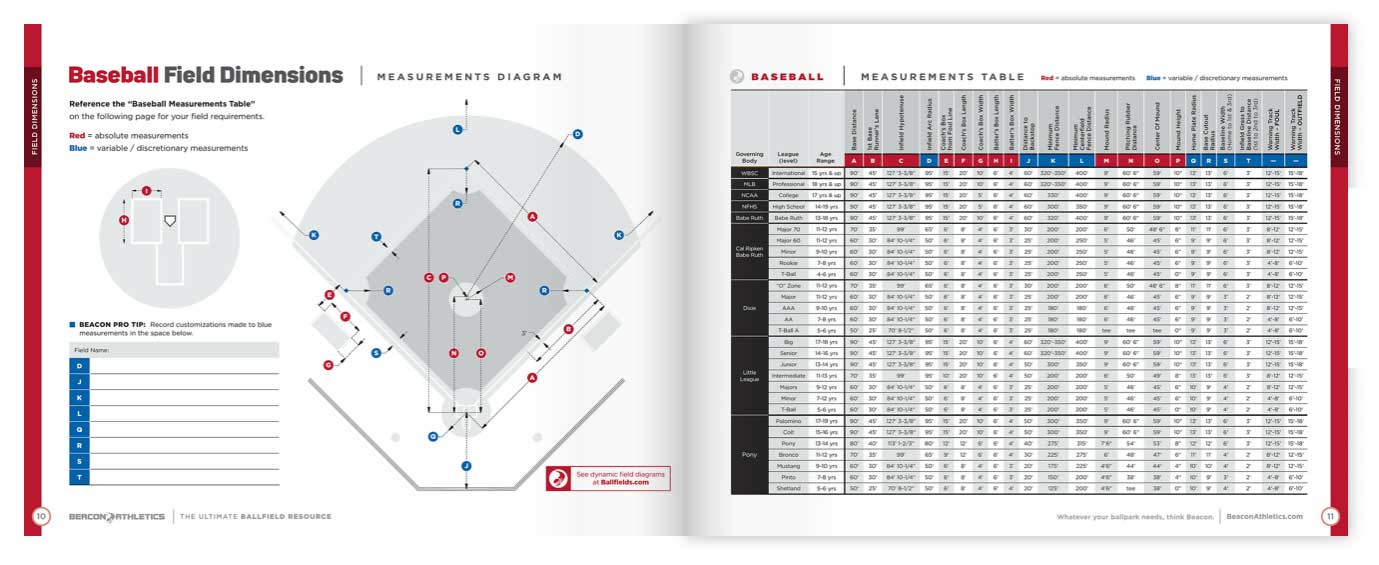
Baseball Field Dimensions

Click on the letters below to see the dimensions for your league’s governing body.

A
B
C
D
E
F
G
H
I
J
K
K
L
M
N
O
P
Q
R
R
R
S


Softball Field Dimensions

Click on the letters below to see the dimensions for your league’s governing body.

A
A
B
C
D
E
F
G
H
I
J
K
K
L
M
N

Pitching Mounds

Professional, College, High School (10-inch Mound)

Click to view larger image

The pitching mound is an 18′ diameter circle. The center is located 59′ from the apex (back point) of home plate along an invisible line extending from the apex through the center of 2nd base.

The front, center edge of the pitching rubber is located 60’6″ from the apex of home plate along this same line.

The top face of the pitching rubber should be elevated 10″ above the surrounding ground to ensure the proper slope can be achieved on the front landing area.

The front slope of the mound is a uniform 1 inch drop for every 1 foot towards home plate, beginning 6″ in front of the pitching rubber.

If desired, bagged clay or unfired clay brick can be added to the table and front slope of the mound to reduce digout and improve footing. This clay layer should be a minimum of 3″ – 4″ thick.

Mound 10

PROFESSIONAL / COLLEGE / H.S. 10″ MOUND MATERIALS
Beacon Pro Bricks Shredded Clay
SQUARE FEET 2-1/4″ DEPTH 4″ DEPTH* 3″ DEPTH 4″ DEPTH*
TABLE 14 60 bricks 60 bricks 11 bags 11 bags
FRONT SLOPE 40 169 bricks 310 bricks 30 bags 40 bags
WINGS (2 total) 25 108 bricks 108 bricks 18 bags 18 bags
TOTAL AREA 79 337 bricks 478 bricks 59 bags 69 bags

* – Only the front slope of mound area requires 4″ depth of clay. Use of clay is recommended only on mounds where proper maintenance practices can be followed regularly.

Cal Ripken-Babe Ruth, Pony (8-inch Mound)

Click to view larger image

The 8″ pitching mound is a 12′ diameter circle. The center is located 47’6″ from the apex (back point) of home plate along an invisible line extending from the apex through the center of 2nd base.

The front, center edge of the pitching rubber is located 50′ from the apex of home plate along this same line.

The top face of the pitching rubber should be elevated 8″ above the surround ing ground to ensure the proper slope can be achieved on the front landing area.

The front slope of the mound is a uniform 1 inch drop for every 1 foot towards home plate, beginning 6″ in front of the pitching rubber.

If desired, bagged clay or unfired clay brick can be added to the table and front slope of the mound to reduce digout and improve footing. This clay layer should be a minimum of 3″ – 4″ thick.

Mound 8

YOUTH 8″ MOUND MATERIALS
Beacon Pro Bricks Shredded Clay
SQUARE FEET 2-1/4″ DEPTH 4″ DEPTH* 3″ DEPTH 4″ DEPTH*
TABLE 9 38 bricks 38 bricks 7 bags 7 bags
FRONT SLOPE 26 110 bricks 202 bricks 20 bags 26 bags
WINGS (2 total) 13 54 bricks 54 bricks 10 bags 10 bags
TOTAL AREA 48 202 bricks 294 bricks 37 bags 43 bags

Little League, Dixie, Cal Ripken-Babe Ruth, Pony (6-inch Mound)

Click to view larger image

The pitching mound is a 10′ diameter circle. The center is located 45′ from the apex (back point) of home plate along an invisible line extending from the apex through the center of 2nd base.

The front, center edge of the pitching rubber is located 46′ from the apex of home plate along this same line.

The top face of the pitching rubber should be elevated 6″ above the surrounding ground to ensure the proper slope can be achieved on the front landing area.

The front slope of the mound is a uniform 1 inch drop for every 1 foot towards home plate, beginning 4″ in front of the pitching rubber.

If desired, bagged clay or unfired clay brick can be added to the table and front slope of the mound to reduce digout and improve footing. This clay layer should be a minimum of 3″ – 4″ thick.

Mound 6

LITTLE LEAGUE 6″ MOUND MATERIALS
Beacon Pro Bricks Shredded Clay
SQUARE FEET 2-1/4″ DEPTH 4″ DEPTH* 3″ DEPTH 4″ DEPTH*
TABLE 3.5 15 bricks Metal spikes not allowed at this level 3 bags Metal spikes not allowed at this level
FRONT SLOPE 20 85 bricks 15 bags
WINGS (2 total) 12 51 bricks 10 bags
TOTAL AREA 36 151 bricks 0 bricks 28 bags 0 bags

Field Areas

Baseball Field Areas

Click on image to zoom

Infield Skin 9,740 sq ft
Mound 255 sq ft
Infield Turf 6,545 sq ft
Home Plate Area 531 sq ft
Baselines 770 sq ft

Refer to the Soil & Topdressing table on “Infield Soil Needs” tab (above) to calculate soil and top dressing needs.

Softball Field Areas

Click on image to zoom

Infield Skin (55′ Arc) 6,143 sq ft
Infield Skin (60′ Arc) 6,890 sq ft
Infield Skin (65′ Arc) 7,674 sq ft
Foul Territory 4,300 – 5,800 sq ft

Refer to the Soil & Topdressing table on “Infield Soil Needs” tab (above) to calculate soil and top dressing needs.

Little League Field Areas

Click on image to zoom

Infield Skin 2,860 sq ft
Mound 79 sq ft
Infield Turf 2,930 sq ft
Home Plate Area 255 sq ft
Baselines 338 sq ft (169 ea.)

Refer to the Soil & Topdressing table on “Infield Soil Needs” tab (above) to calculate soil and top dressing needs.

Infield Soil Needs

Infield Soil Needs

Soil - Click to view larger image

Type of Infield Total
Exposed
Skin
(sq ft)
INFIELD SKIN BASE SOILS INFIELD SKIN TOPDRESSING MATERIALS
Approximate volume of infield soil needed (compaction factor 30%) Magic Mix™ Crushed Aggregate Diamond Pro® Infield Conditioner Turface® or Diamond Pro® Pro League
Calcined Clay
4″ Deep Profile
(cu. yds.)
6″ Deep Profile
(cu. yds.)
¼” depth ½” depth ¼” depth ½” depth ¼” depth ½” depth
BASEBALL FIELD (90′ bases with a 95′ infield arc)
GRASS infield 11,296 181 272 12 tons 24 tons 8 tons 16.5 tons 5 tons 9.5 tons
SKINNED infield 17,841 286 430 19 tons 37 tons 13 tons 26 tons 7.5 tons 15 tons
LITTLE LEAGUE FIELD (60′ bases with a 50′ infield arc)
GRASS infield 3,532 57 104 4 tons 8 tons 2.5 tons 5 tons 1.5 tons 3 tons
SKINNED infield 6,462 104 156 7 tons 13.5 tons 5 tons 9.5 tons 3 tons 5.5 tons
SOFTBALL FIELDS
55′ Arc 10,443 168 251 11 tons 22 tons 7.5 tons 15 tons 4.5 tons 9 tons
60′ Arc 11,190 180 269 11.5 tons 23.5 tons 8 tons 16.5 tons 4.5 tons 9.5 tons
65′ Arc 11,974 192 268 12.5 tons 25 tons 9 tons 17.5 tons 5 tons 10 tons

A. Formula for Estimating Infield Soil Needs

To estimate the amount of soil needed to add to your infield skin to bring it up to the proper grade, use the following formula:

Area of Infield Skin (sq ft) X
Depth of Material To Be Added
= Cu. Yds. of Soil
27 cubit feet per cubic yard Needed

For a more accurate estimation of soil needed, compaction should be factored into this equation as well. Ask your soil supplier for the compaction factor of the soil you will be ordering. If, for example, the CF (Compaction Factor) is 43%, then multiply the amount of soil suggested from the equation above by 1.43. If the compaction factor was 30%, then multiply it by 1.30.

EXAMPLE:

Area of Infield Skin (sq ft) X
Depth of Material To Be Added
= ?
27 cubit feet per cubic yard Needed

ANSWER: 90.74 cu yd of soil is required to raise the infield skin 2″

B. Square Footage of Skinned Areas on Infields

The table below shows for different portions of the skinned areas of infields. The softball field areas cover only the skinned area in fair territory, from the foul lines inward. No skinned area in foul territory was included in the softball calculations because of the wide variation of these dimensions from one field to the next.

Infield Size Infield Skin 1st & 3rd Baselines Mound Home Plate Area
Regulation Baseball Infield w/ 95′ arc 9,740 385 ea 255 531
Little League Infield w/ 50′ arc 2,860 169 ea 79 255
Skinned Softball Field w/ 55′ arc 6,143 Assumes recommended dimensions.
Areas are in square feet.
Skinned Softball Field w/ 60′ arc 6,890
Skinned Softball Field w/ 65′ arc 7,674
INCHES TO FEET CONVERSIONS
1″ = 0.0833′ 7″ = 0.5833′
2″ = 0.1667′ 8″ = 0.6667′
3″ = 0.2500′ 9″ = 0.7500′
4″ = 0.3333′ 9″ = 0.8333′
5″ = 0.4167′ 10″ = 0.9167′
6″ = 0.5000′ 12″ = 1.000′
COMPACTION FACTOR EXAMPLES
If CF is: Multiply by:
10% 1.1
20% 1.2
30% 1.3
40% 1.4
50% 1.5

Estimated Quantity of Soil in a Stockpile

Height of Stockpile DIAMETER OF BASE OF SOIL STOCKPILE
QUANTITIES ARE SHOWN IN CUBIC YARDS
1 cu yd of DuraEdge Infield Soil or FieldSaver material = 1.35 tons
5′ 10′ 15′ 20′ 25′ 30′ 35′ 40′ 45′ 50′ 55′ 60′ 65′ 70′ 75′
4′ 1 3.9 8.7 15.5 24.2 34.8 47.5 62
6′ 1.4 5.8 13 23.3 36.3 52.3 71.2 93 117.7
8′ 1.9 7.7 17.4 31 48.5 69.8 95 124 157 193.8
10′ 9.7 21.8 38.8 60.6 87.2 118.7 155.1 196.3 242.3 293.2
12′ 26.2 46.5 72.7 104.7 142.5 186 235.6 290.7 351.8 418.7
14′ 54.3 84.8 122.1 166.2 217.1 274.8 339.2 410.4 488.4 573.2
16′ 96.9 139.5 189.9 248.1 314.1 387.6 469 558.2 655.1 759.8
14′ 157 213.7 279.1 353.3 436.1 527.7 628 737 854.8 981.2
16′ 174.4 237.4 310.1 392.6 484.6 586.3 697.8 818.9 949.6 1,090.2

Function of Various Soil Entities

A soil is made up of three types of soil particles: sand, silt and clay. Each of these particles plays a vital role in the success of the infield skin. In order for the soil to provide ample support for athletic play, it will need to have the proper density of particles to fully stabilize the soil surface.

SAND — It’s function in the infield soil is to provide the structural stability. When sand is present in proper amounts and sizes, it creates “pore space” or “air space” which leaves room for the smaller particles of silt and clay. Because of its large particle size, sand should take up the majority of the volume in your infield soil. Sand is usually divided into five sizes ranging from very fine to very coarse. For infield soils the majority of the sand should be in the medium to very coarse range. An infield soil with the proper volume and sizes of sand will easily support athletic traffic on the surface — even in wet conditions. Conversely, infield soils with large volumes of fine and very fine sand will lack stability.

SILT — This is the soil particle that is sized between sand particles (larger) and clay particles (smaller). Because of this, silt helps to bind sand and clay particles together in a mix. However, excess silt can cause many problems on an infield ranging from a greasy surface when wet to a very dusty infield when the soil is dry.

How much silt is needed? The ideal silt content is a ratio which is equal to or ½ the clay content. Reference the SCR Scale below for the proper Silt-to-Clay Ratio.

CLAY — Represents the smallest particle size in an infield soil and it provides color and moisture retention. In general, higher clay content in a mix requires more maintenance.

How much clay is needed? The ideal clay content is a ratio which is equal to or 1½ times the silt content. Reference the SCR Scale below for the proper Silt-to-Clay Ratio.


SCR: ITS IMPORTANCE TO INFIELD SOILS

The Silt-to-Clay Ratio This number is arrived at by taking the percent silt reported in a soil test and dividing it by the percent clay from the test. Use this SCR Scale to judge how this entity of your infield soil measures up.

As mentioned above regarding clay content, the ideal SCR range for any infield soil is between 0.5 and 1.0, as indicated in green in the SCR Scale. When the SCR is between 1.0 and 2.0 — the “elevated” range — these fields can usually be fixed by merely placing a topdressing on the infield skin. Typically, a topdressing will address these elevated SCR problems in the soil if they are managed properly. Soils with an SCR of around 2.0 or higher will definitely need to be amended to adjust the SCR closer to the desired level. Overall sand content and sand size distribution will need to be adjusted as well in these fields. High SCR infield soils typically will be very slippery or greasy when wet, and very dusty when dry. Both of these conditions are due to excessive silt content in the infield soil. From Beacon’s infield soil testing experience, we have found that most of the infield soils tested had a high to excessive SCR, especially in the eastern half of the United States. These fields typically are very high in silt and sometimes high in fine and very fine sand content as well. That combination of high SCRs and high fine to very fine sand content results in some very unstable infield soils when wet. Infield soils that have a low SCR do occur, but not very often. Low SCR fields will typically suffer from either being too loose and sandy or they could have too high a clay content which will cause chunking-out on the infield skin.

Recommended Infield Soil Specifications

PROFESSIONAL LEVEL

This level of field will always have access to water and be maintained on a regular or daily basis, often with crew of several people. Examples of these type fields include professional ballparks (MLB , MiLB ) and Division 1 colleges and universities.

Sand: Total content 58% to 62%. 38% to 45% of the total sand content shall be composed of medium, coarse and very coarse sand particles. Sand shape should be sub-angular to sub-rounded with low to medium sphericity.

Silt & Clay: The combined amount of silt and clay shall be between 38% and 42%.
The silt-to-clay ratio (SCR), which is found by dividing the percent silt by the percent clay,
shall be between 0.5 and 1.0. (Reference SCR Scale on the previous page)


INTERMEDIATE LEVEL

This level of field will always have access to water and be maintained on a somewhat limited basis by usually one person or maybe the team who uses the field. Examples of these type fields include colleges and universities, some high schools or sports complexes.

Sand: Total content 65% to 69%. Of the total sand content, 45% to 50% shall be composed of medium, coarse, and very coarse sand particles. Sand shape should be sub-angular to sub-rounded with low to medium sphericity.

Silt & Clay: The combined amount of silt and clay shall be between 31% and 35%. The silt-to-clay ratio (SCR), which is found by dividing the percent silt by the percent clay, shall be between 0.5 and 1.0. (Reference SCR Scale on the previous page)


RECREATIONAL LEVEL

This level of field typically will not have access to water and is maintained on a volunteer or irregular basis. Examples of these type fields include most school and park fields.

Sand: Total content 70% to 75%. >50% of the total sand content shall be composed of medium, coarse and very coarse sand particles. Sand shape should be sub-angular to sub-rounded with low to medium sphericity.

Silt & Clay: The combined amount of silt and clay shall be between 30% and 25%.
The silt to clay ratio (SCR), which is achieved by dividing the percent silt by the percent clay, shall be between 0.5 and 1.0. (Reference SCR Scale on the previous page)


NOTE:

To insure the quality of a supplied infield, a sample of the material produced for you should be sent to a soil testing lab of your choice. If the project is one that requires a large volume of infield soil, then a soil test should be conducted at the rate of one per 200 tons of material delivered to the job site. All testing should be performed by the same soil testing agency. Test results should be compared to and successfully fall into the range provided in these Infield Soil Specifications.

No particles in the infield mix shall exceed 3 millimeters in size and no more than 5% of particles shall be retained on the 2 millimeter screen.

Why and How to Test Your Infield Soil

Managing Your Infield Soil is a Science.

An infield skin can be the source of unlimited frustration for a professional groundskeeper. However, identifying the composition of the infield mix will allow any groundskeeper to more accurately predict how the infield skin will perform in less than ideal weather.

Managing the skinned portion of an infield is a science — not guesswork. For this reason, you must know your infield soil composition before taking any action to amend it. Soil testing provides quantitative data that helps to identify the shortcomings of an infield mix. After interpreting your test results, you will be able to make an educated decision about the amendment material to choose.

Infield soil tests are a diagnostic tool that many soil testing facilities can perform, but very few can interpret what those results mean in terms of playability on an infield. Choose a soil testing company that understands how the composition of an infield soil affects game day performance. Beacon Athletics has over 10 years experience of infield soil test interpretation and analysis. Our team of soil scientists and a former Major League groundskeeper work with one of the top soil testing firms in the country to be sure you get accurate testing and analysis. Just follow the
protocol below to harvest your sample and send it in for testing.

Infield Soil Testing Protocol

  1. Randomly choose 8 to 12 locations around the infield skin that you will pull samples from. This is done to assemble a good representative sample of the skin area.
  2. If your infield has a topdressing material on it, scrape or sweep it away completely from the areas you are about to sample to prevent contamination.
  3. Find a box or storage container to compile all of your samples. Then, using a small shovel, dig into the infield soil. Collect a 3″ x 3″ sample from each location, no deeper than 3 inches, and toss them into the box.
  4. Once you have collected all of your samples in the box, pulverize the soil as much as possible and mix all of the samples together. Use a quart sized zipper storage bag, label the bag in a way that you will remember from which field or complex the samples were taken. Fill the zipper bag almost full and seal it. Your sample is now ready to be sent to your soil testing lab for testing and analysis. Remember, Beacon Athletics can conduct your infield soil test and analysis.
  5. Normally, you should expect to see results from your test in about 7 to 10 days. If your soil lab does not analyze results, we can help. Call or email Beacon Athletics and send us your test results and we’ll analyze your results for you.

Understanding a Soil Test Report

  1. Field Classification Icon. Identifies what classification the field being tested is targeted at. Water availability and maintenance resources (manpower) dictate the field classification and it’s respective infield soil specifications.
  2. Sand content box. Indicates what the total sand content specification is for the field classification indicated above it.
  3. Soil texture triangle. The blue star indicates where the tested soil lies on the triangle. The three strips showing the SCR scale in the lower left corner of the triangle indicate where the three soil specs for the different field classifications lie on the graph. Ideally, the infield soil tested should land in the bright green area indicated on this graph.
  4. Texture analysis. Indicates the total percentage of sand, silt and clay found in the infield soil sample. Check this percentage of sand with respect to what is specified in the Sand Content Box (#2).
  5. SCR Number. The SCR number, or silt-to-clay ratio, is found by dividing the amount of silt in the infield soil by the amount of clay. The ratio is indicated in the box and the color used to fill the box reflects where the SCR relates on the SCR scale. The ideal SCR for ALL infield soils is between 0.5 and 1.0.
  6. Coarse sand Percentage. Identifies the total combined amount of the medium, coarse, and very coarse sand that is present in the overall soil sample. The background of this box will be white when the number does not match the specs for the classification that is being testing for. When the amount falls into the proper spec for the desired classification, the background will turn the color of the matching specification shown in the boxes below the sand fraction analysis.
  7. Sand shape analysis. Indicates the shapes of the sand particles that were present in the tested sample. Sphericity indicates whether the shape of the sand particles were more globe shaped or elongated. The Angularity indicates how smooth or jagged the surface of the sand particles were. The green box indicates the “ideal” shapes preferred for an infield

© 2011 Beacon Athletics, Division of Rainbow Group, LLC. All rights reserved. This material may not be republished, rewritten, or redistributed (including electronically caching) without prior written consent of Beacon Athletics.

Comments are closed.